


News

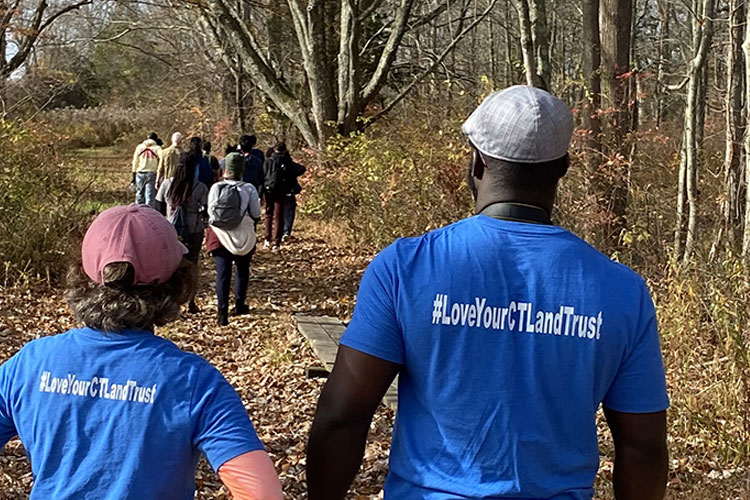
After rescheduling once and with a Nor’easter on the doorstep, we managed to pull together a wonderful group for a Conservation Conversation event with our partners at Audubon Connecticut at the Bent of the River Sanctuary in Southbury. These events are special for many reasons, but primary among them is bringing state and local decision-makers out to see the direct impact of their work.
Bent of the River’s Executive Director, Robin Ladouceur, and Land and Facilities Manager, Glen Somogie, welcomed attendees and guided us through the work being undertaken at the sanctuary. Southbury First Selectman Tim O’Neil was in attendance and shared his personal connection to the Bent, recalling growing up in Southbury and coming to swim in the river there and how much it meant to see it preserved and open to the community. We were also joined by representatives from the Connecticut Department of Energy and Environmental Protection (CT DEEP) Forestry and the Connecticut Department of Agriculture, both of which provided CLCC with the funding for our climate-smart grant programs and are crucial partners in supporting these projects. Representatives from several of our regional land trust partners attended as well, highlighting the strong regional collaboration and broader impact of these projects.
Audubon Connecticut’s Bent of the River Sanctuary received a planning grant through CLCC’s Climate-Smart Land Stewardship Program in 2024 to develop a forest management plan. Funding for this program was made possible by the Climate-Smart Farming: Agriculture and Forestry Grant, administered by the Connecticut Department of Agriculture. Audubon engaged private forester Eric Hansen of Ferrucci & Walicki, LLC, to craft a personalized plan for their 700+ acre property. This plan takes a close look at the forest’s current health and road map for the next decade, turning big conservation goals into actionable management steps. The plan emphasizes removing invasive plants, strategically thinning overcrowded forest stands, and planting trees on steep slopes along riverbanks. This work encourages the conditions migrating birds need to find shelter during critical stages of their life cycle, while building climate resilience to protect long-term soil, water, and forest health.
Climate resilience is the ability of a natural environment to absorb, bounce back from, and adapt to climate-driven disturbances such as severe storms, droughts, unseasonable heat, and increased pest or disease pressure without losing its fundamental ecosystem functions. Forests managed with climate resilience in mind simultaneously provide quality habitat for wildlife. Instead of a uniform forest where trees are mostly the same size and species, a healthy forest features a diverse mix: large canopy trees, mid-sized saplings, understory shrubs, standing dead snags, and open patches of sunlight.
This structural variety creates a rich tapestry of habitats. Different bird species rely on different forest types layers for their life cycle. While some nest high up in mature treetops, many others rely on areas of young forest created by gaps in the canopy to nest and rear their young. By encouraging and protecting this natural variety, a managed forest can better absorb environmental stressors while providing wildlife with everything they need to thrive.
With the development of this plan complete, Bent of the River applied for and was awarded a Climate-Smart Forest Stewardship implementation grant through CLCC to bring their vision to fruition. Funding for this implementation grant is provided by the U.S. Forest Service through its Forest Stewardship Program, as administered by CT DEEP. This work will get underway this fall and over the next few years, so keep an eye out for updates. Our partners at Audubon Connecticut are taking vital strides to ensure the sanctuary thrives, and CLCC is proud to provide this funding continuity and celebrate this proactive work being undertaken for our forests and birds.


![types]](https://ctconservation.org/wp-content/uploads/Ricky-Bentley-Headshot.jpg "types]")
